
GMV partners with CSIC to enable a secure transition to post-quantum cryptography
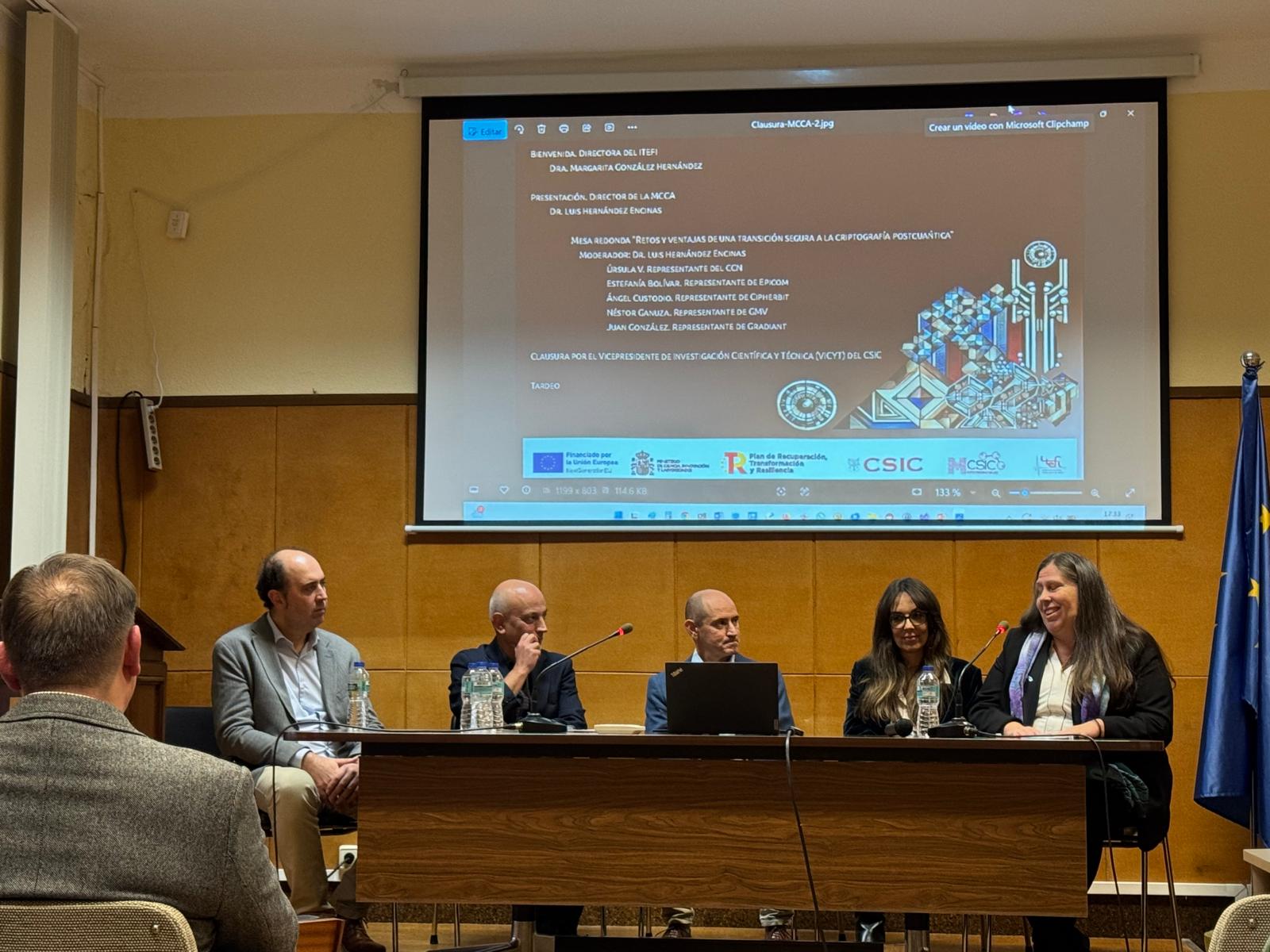
El 4 de diciembre de 2025 se celebró en el Instituto de Tecnologías Físicas y de la Información “Leonardo Torres Quevedo” (ITEFI), una mesa redonda centrada en los retos y ventajas de una transición segura a la criptografía poscuántica. El encuentro reunió a representantes de organismos públicos y empresas lideres en el sector de la criptografía en el ámbito nacional, entre ellas el CCN, EPICOM, Cipherbit, Gradiant y GMV.
La mesa redonda se enmarcó en el acto de clausura de la Microcrendencial en Criptografía Avanzada, impartida por el Consejo Superior de Investigaciones Científicas (CSIC) y financiada por los fondos Next Generation de la Unión Europea, dentro del Plan de Recuperación, Transformación y Resiliencia del Ministerio de Ciencias, Innovación y Universidades.
On December 4, 2025, a roundtable discussion focused on the challenges and advantages of a secure transition to post-quantum cryptography was held at the Institute of Physical and Information Technologies “Leonardo Torres Quevedo” (ITEFI). The event brought together representatives from public institutions and leading companies in the national cryptography sector, including the CCN, EPICOM, Cipherbit, Gradiant, and GMV.
The roundtable took place as part of the closing event of the Microcredential in Advanced Cryptography, delivered by the Spanish National Research Council (CSIC) and funded by the European Union’s Next Generation EU funds under the Recovery, Transformation, and Resilience Plan of the Ministry of Science, Innovation, and Universities.
The event was chaired by the CSIC Vice President for Scientific and Technical Research (VICYT), Dr. José María Martell Berrocal, and featured contributions from the Director of ITEFI, Dr. Margarita González Hernández, and the Director of the microcredential program, Dr. Luis Hernández Encinas, along with representatives from the participating companies.
CSIC’s Microcredential in Advanced Cryptography is a program of excellence in modern and post-quantum cryptography. With a highly specialized approach, it provides top-level technical training at the national level and addresses the growing and urgent demand for cryptography experts in both the public and private sectors.
GMV, together with the National Cryptologic Center, the Guardia Civil Intelligence Directorate, the Cybersecurity Coordination Office of the Ministry of the Interior, and other leading companies in the cryptographic sector such as EPICOM, DEKRA, Gradiant, Ikerlan, and Cipherbit, sponsors this microcredential and delivers a master class focused on the current challenges of cryptography in European space programs.
GMV is fully aware that over the next decade (2026–2035), all projects and systems in which it is involved—both in the space sector and in key areas such as defense, security, aeronautics, cybersecurity, healthcare, transportation, telecommunications, public administration, and banking—will need to undergo a profound cryptographic transformation. This process requires a secure and orderly transition to post-quantum cryptography environments, with the capacity for adaptation and evolution. With this objective in mind, GMV has maintained a close and ongoing collaboration with CSIC since 2024.