
Celeste IOD-1 enters final launch preparations in New Zealand
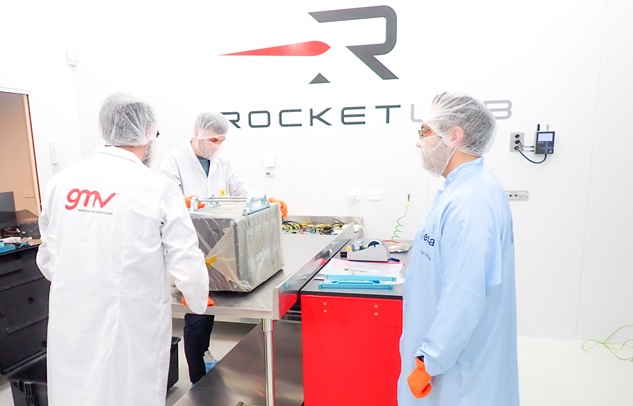
Celeste IOD-1, developed by GMV and Alén Space under the European Space Agency’s (ESA) Celeste In‑Orbit Demonstrator (IOD) programme, has arrived at Rocket Lab’s Launch Complex 1 in Māhia, New Zealand. The spacecraft reached the site on 23 February and is now preparing to enter the final phase of launch campaign operations ahead of its planned liftoff later this month.
Celeste is ESA’s strategic programme to add a navigation layer in low Earth orbit (LEO) to complement Galileo and EGNOS, with the goal of improving the accuracy, resilience and security of Positioning, Navigation and Timing (PNT) services in Europe. The In-Orbit Demonstrator (IOD) is the programme’s first milestone and will validate key LEO-PNT technologies in flight prior to their possible future operational deployment.
The Celeste IOD phase is being executed by two European consortiums in parallel and will comprise a total of 11 satellites plus one spare. GMV, as one of the prime contractors, is responsible for the complete end-to-end mission, including system definition and design, the space and ground segments, the user segment and operations, for 6 of the demonstrator satellites.
From cleanroom to launch site
Following the successful completion of its testing and qualification campaign, Celeste IOD-1 was formally declared ready for flight and departed GMV’s facilities on 8 February. After a carefully controlled packing process under strict cleanliness and environmental conditions, the satellite was secured inside its dedicated transport container to ensure structural integrity, thermal stability and contamination control during transit.
The spacecraft subsequently travelled to Germany for launch integration activities at Exolaunch’s premises before being shipped to Rocket Lab’s Māhia Launch Complex in New Zealand, where it arrived on 23 February.
In the coming weeks, the two satellites IOD-1 and IOD-2 comprising the Celeste In-Orbit Demonstrator mission will undergo final launch campaign operations, including post-shipment inspections, functional verifications, battery preparations and final integration procedures and mating prior to encapsulation and liftoff aboard a Rocket Lab Electron vehicle.
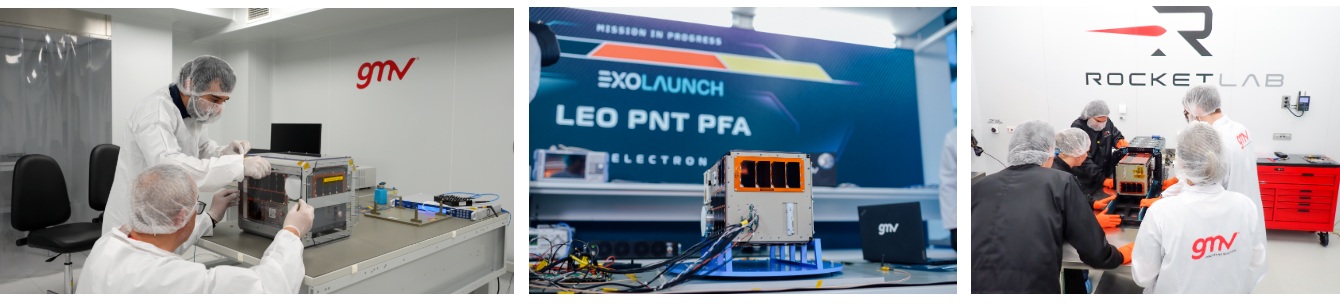
Demonstrating next-generation LEO navigation
Once in orbit, Celeste will begin with two demonstrator satellites — IOD-1 and IOD-2 — to secure the assigned frequency filings and to test representative navigation signals until the end of the year. The mission will demonstrate autonomous precise orbit determination without reliance on mission ground infrastructure, as well as stronger radionavigation signals in L- and S-band from low Earth orbit.
By demonstrating the benefit of integrating LEO capabilities into a multi-orbit architecture alongside Galileo (MEO), Celeste aims to enhance resilience against interference and expand advanced navigation services. Operating at altitudes between 500 and 560 km, the Celeste demonstrators will inform how a complementary LEO layer can enhance Europe’s Galileo system in medium Earth orbit.
Eight additional, larger satellites are currently under development, expanding on the initial demonstrators as part of a 12-satellite mission—11 operational spacecraft plus one spare—and paving the way for subsequent launches from 2027 onwards.