
With the EROSS-IOD project, GMV achieves TRL 6 for key space robotics technologies
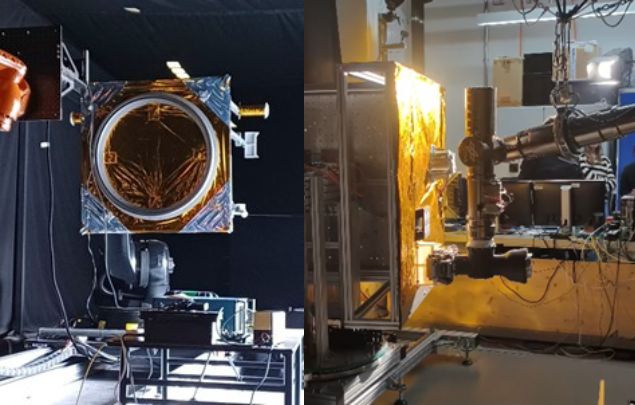
The final demonstration for the project known as EROSS-IOD (European Robotic Orbital Support Services - In Orbit Demonstrator) recently took place at the German Aerospace Center (DLR), marking completion of the project. This milestone represents a decisive step forward along Europe’s on-orbit servicing roadmap, with validation of technologies that will be fundamental elements of future missions for autonomous servicing, resupply, and assembly.
During the demonstration, the technologies developed by GMV fulfilled the main objective of advancing the technical readiness of strategic European technologies, with a TRL 6 maturity level achieved for ERGO (autonomy), ESROCOS (robotic control operating system), ROB_DFF (data fusion), and Model-Based Tracking (autonomous computer vision).
In July of 2025, GMV passed the TRB for the Servicer Vision System, by using life-sized models and representative materials to successfully demonstrate the use of computer vision during the critical approach phase of the last 10 meters.
Then, on December 18th, delegations from the European Commission and member countries attended a Robotic Capture & Assembly Demo at the German Aerospace Center. During this demonstration, tests were performed for capturing a prepared satellite and an unprepared satellite, along with use of the CAESAR arm to assemble orbital replaceable units (ORUs). The results of this demonstration were a great success for the technologies developed by GMV: ERGO was able to orchestrate a fully autonomous capture, and thanks to ROB_DFF, the controller was able to receive precise information from the CAESAR arm’s onboard sensors, with both of these elements operating on the ESROCOS platform.
With completion of the EROSS-IOD project, GMV has strengthened its contribution in the field of space servicing, giving Europe’s space industry the capabilities needed for sustainable and autonomous operation in the new orbital economy.
This project is funded by the European Union. The views and opinions expressed in this article are solely those of the author and do not necessarily reflect those of the European Union or HADEA, which are not responsible for any use that may be made of the information contained herein