MYRIAD
Mutli-source information sYstem based on Remote sensing aI Analytics to support the strategic Defence domain
A consortium for the project known as MYRIAD (Mutli-source information sYstem based on Remote sensing aI Analytics to support the strategic Defence domain) is participating along with two other consortiums in a technological challenge for multi-source satellite imagery analysis, as part of the European Defence Fund’s EDF-2024-LS-RA-CHALLENGE-SPACE-MSIAP call. This challenge has the objective of investigating ways of improving analyses derived from satellite imagery, for applications in defense.
The purpose of the project is to update the proposed solutions, via four innovation cycles with annual improvements. The membership of the End User Board for the challenge will consist of representatives from the defense ministries of various European countries, and the board’s contributions will play an essential role in promoting updates to the proposed solutions, which will be deployed as part of the infrastructure at the European Union Satellite Centre (SatCen). The MYRIAD project will be focused on improvements in the following key areas:
Development of advanced technologies for analysis of optical and radar images, to improve detection of objects using artificial intelligence.
Performance evaluation and validation for the technologies developed.
A demonstration based on user testing, to ensure operational performance and relevance.
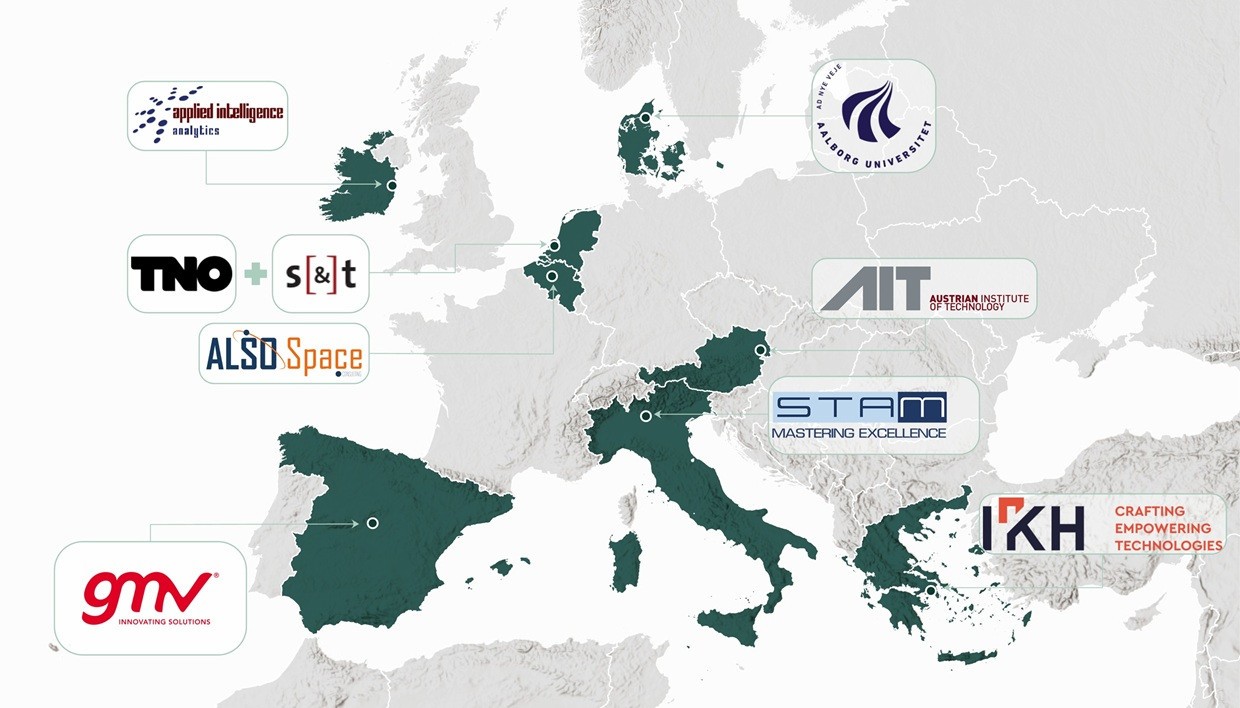
GMV will be acting as coordinator for a consortium consisting of nine European members, with the others being the Netherlands Organisation for Applied Scientific Research (TNO), the Austrian Institute of Technology (AIT), the University of Aalborg (AAU), IKNOWHOW (IKH), APPLIED INTELLIGENCE ANALYTICS LIMITED (AIA), ALSO SPACE, STAM, and S&T, and it will also be leading implementation of the project and the following specific work packages:
Comprehensive project management, which includes progress monitoring for the work packages, tasks, risks, delays, mitigation plans, and corrective actions; interaction with other initiatives; and communication activities.
Feasibility study and technical specifications, which consists of finding an optimal solution by assessing the state of the art for the technologies that will be used; ensuring that the solutions are aligned with defense procedures and operations; defining the technical specifications for all of the analytical models; and defining the functionalities for the demonstrator.
Implementation of the solutions via a workflow that allows activation of an analytical module, based on input data obtained during four annual test campaigns carried out over a period of four years.
For more information, please contact us.